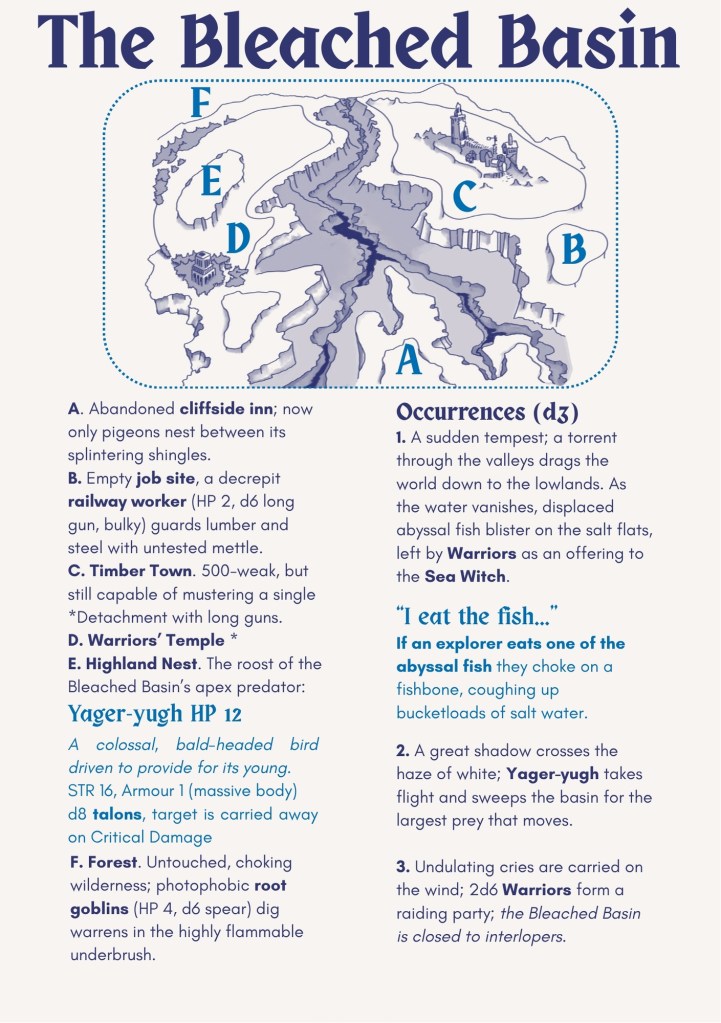
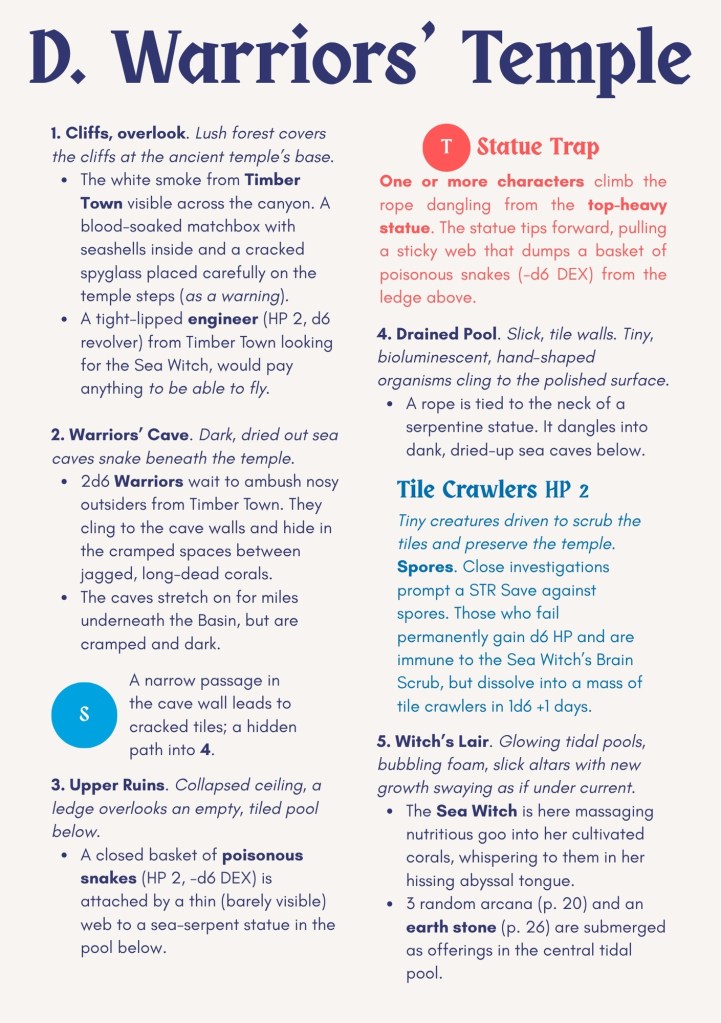
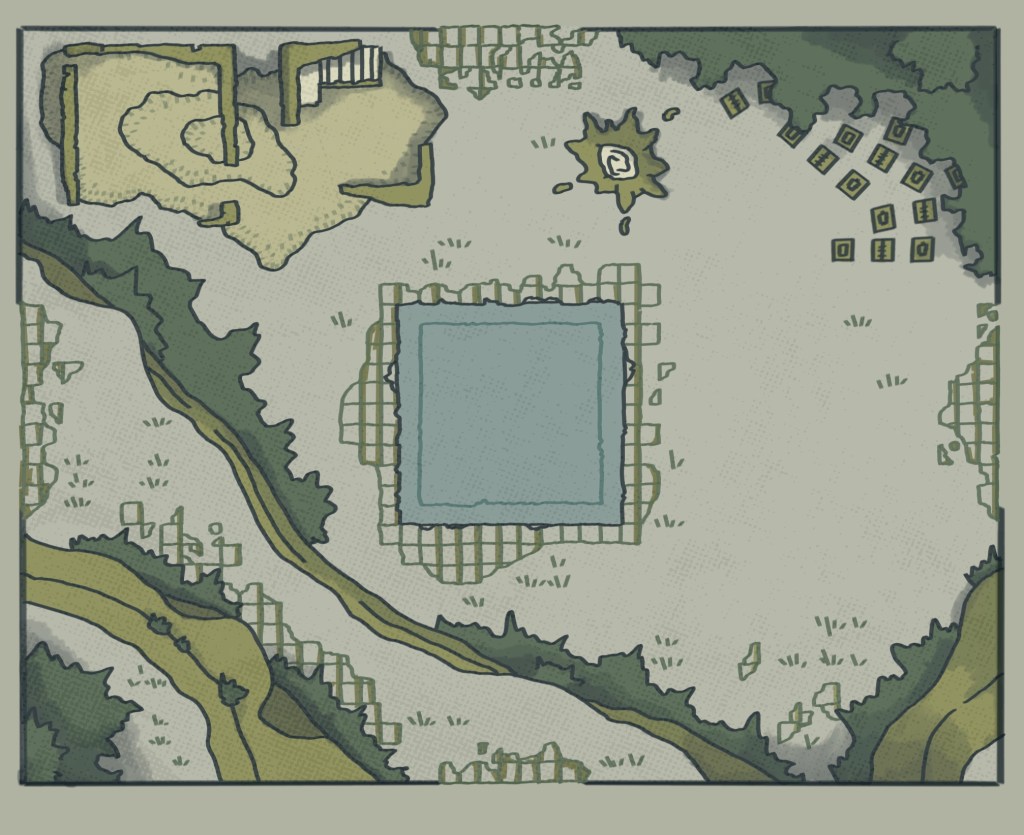
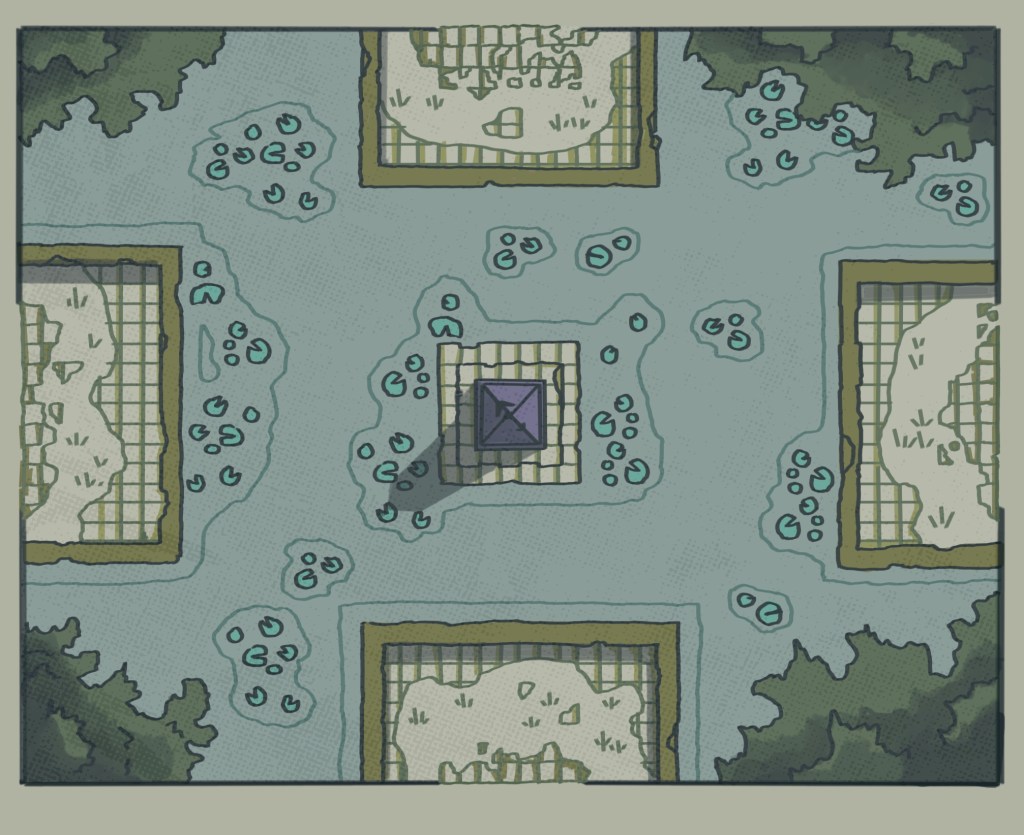
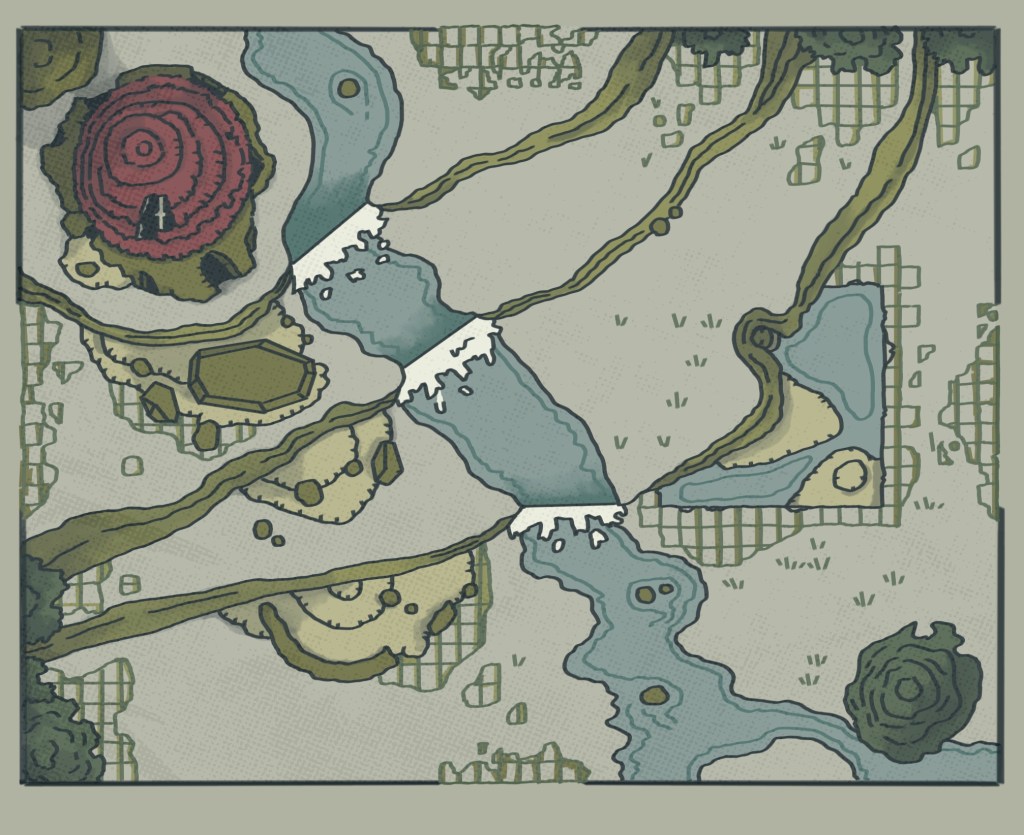
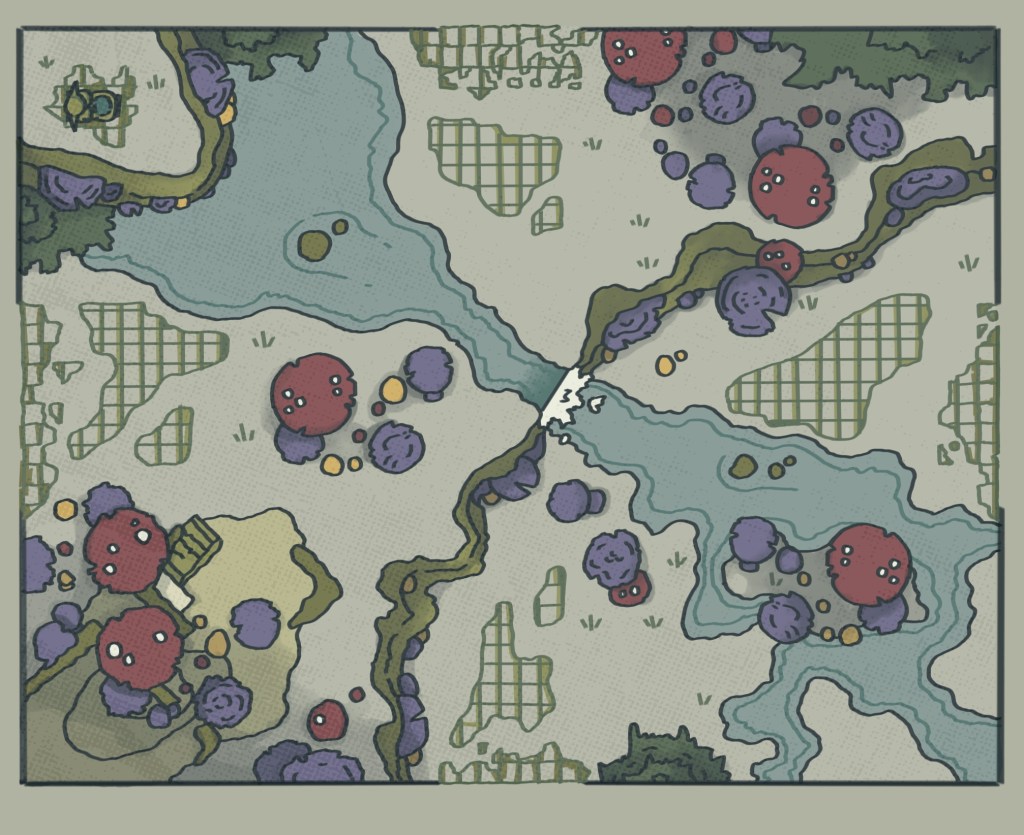
Judging and rating for the Appendix N Jam was extended to mid-October, but I already feel like I have the feedback I need to deliver the definitive version of my adventure, Warriors of the Bleached Basin. So today, I’ve released the Director’s Cut–a version that exists outside the boundaries of the competition.
The Director’s Cut isn’t intended to replace my original submission for ranking purposes, obviously. If you’re a jam participant, I recommend not even looking at this until you’ve read and rated my original entry (let’s keep it fair!). But I had planned to move on from this project by the end of September and, unlike the judges, I have no commitments. Picture me as a hooded ranger in the corner of the tavern, sliding forth forbidden lore. I hope you’ll take a look and let me know what you think!
What’s Changed?
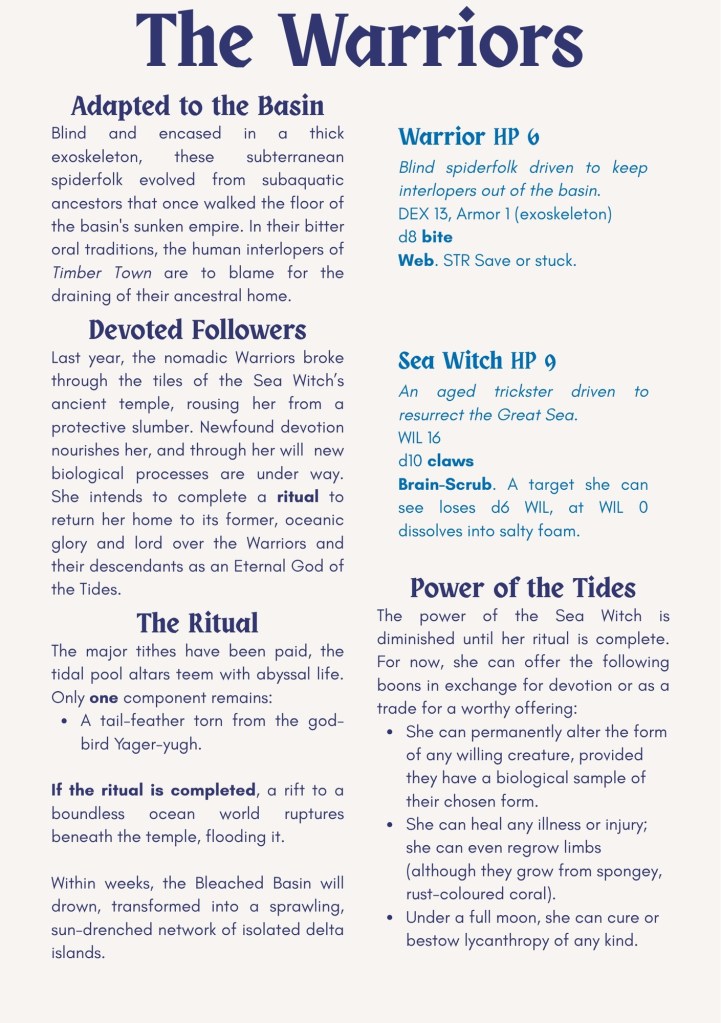
I added two A5 pages to my entry, inspired by some really insightful critiques of my entry. That’s it, just two more pages. Despite a few people asking about an expanded edition, this remains a concise piece for now.
I’m thrilled the setting resonated with so many, but those extra locations in the Bleached Basin don’t actually need expanding. That isn’t why they’re there. They’re sparks for your group’s improv: toys that ground the setting in its pulpy science-fantasy roots. The wilderness crawl offers the illusion of a larger world without ruining the intrigue. After all, you don’t really want extra scenes about the Jawas when you’re watching Star Wars for the first time. The focus of the adventure should remain on the explorers–the players–and their encounters with the titular Warriors.
I also made some major changes to how information is presented. As one Redditor put it, I had “the where mixed with the what and the who.” With two additional pages, I can give dedicated space to both the dungeon key and the villains.
Thank you to everyone who looked at or rated my original submission, and to everyone who took the time to leave feedback in the comments or on Reddit. It seriously warms my heart to know this community is filled with so many thoughtful creators, and I’m proud to showcase my work alongside yours.
Check out the Director’s Cut of Warriors for the definitive experience. It’s free right here.
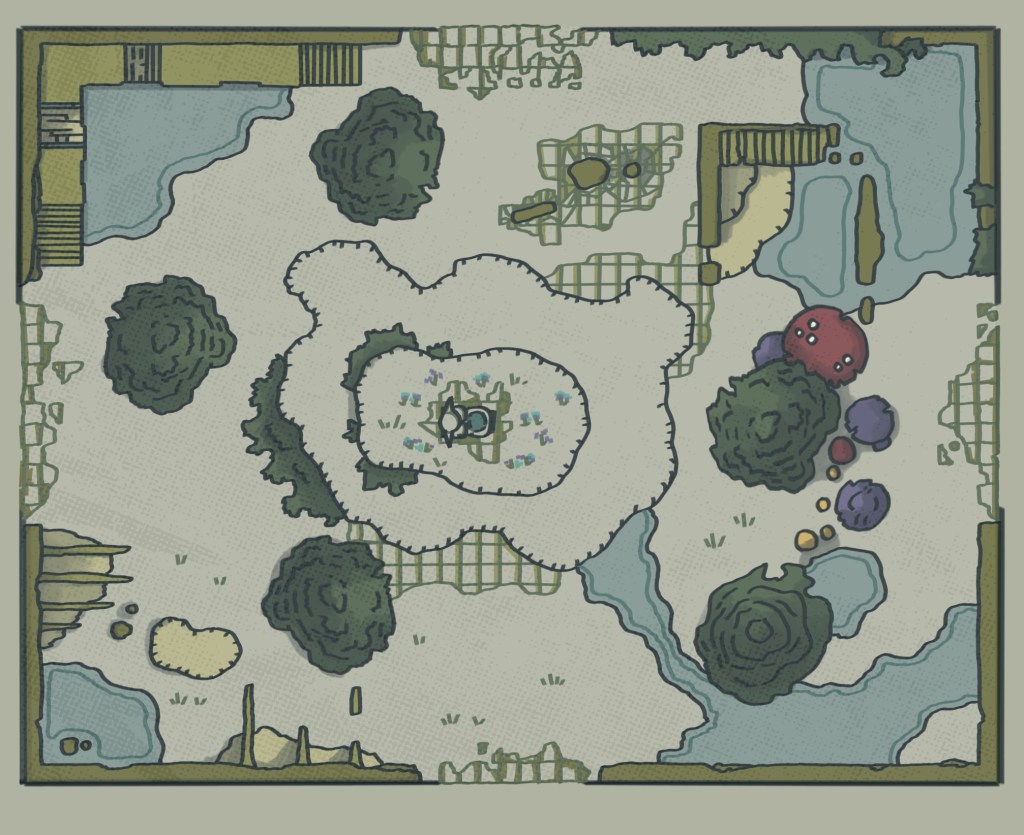
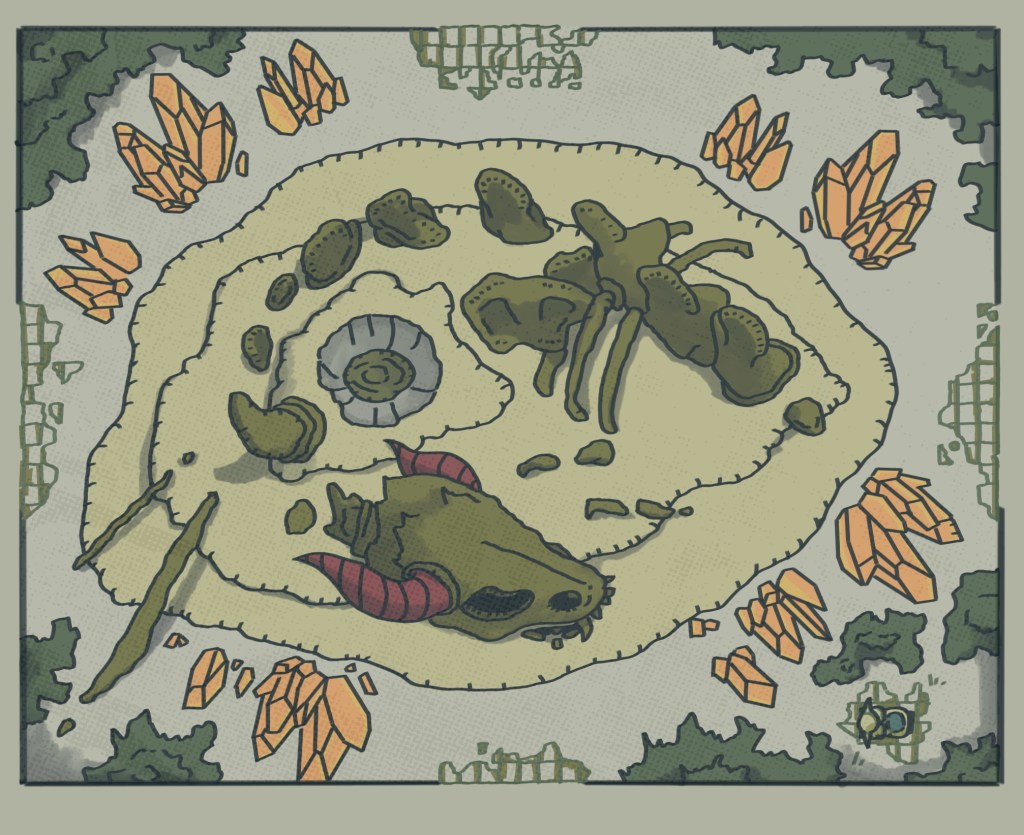
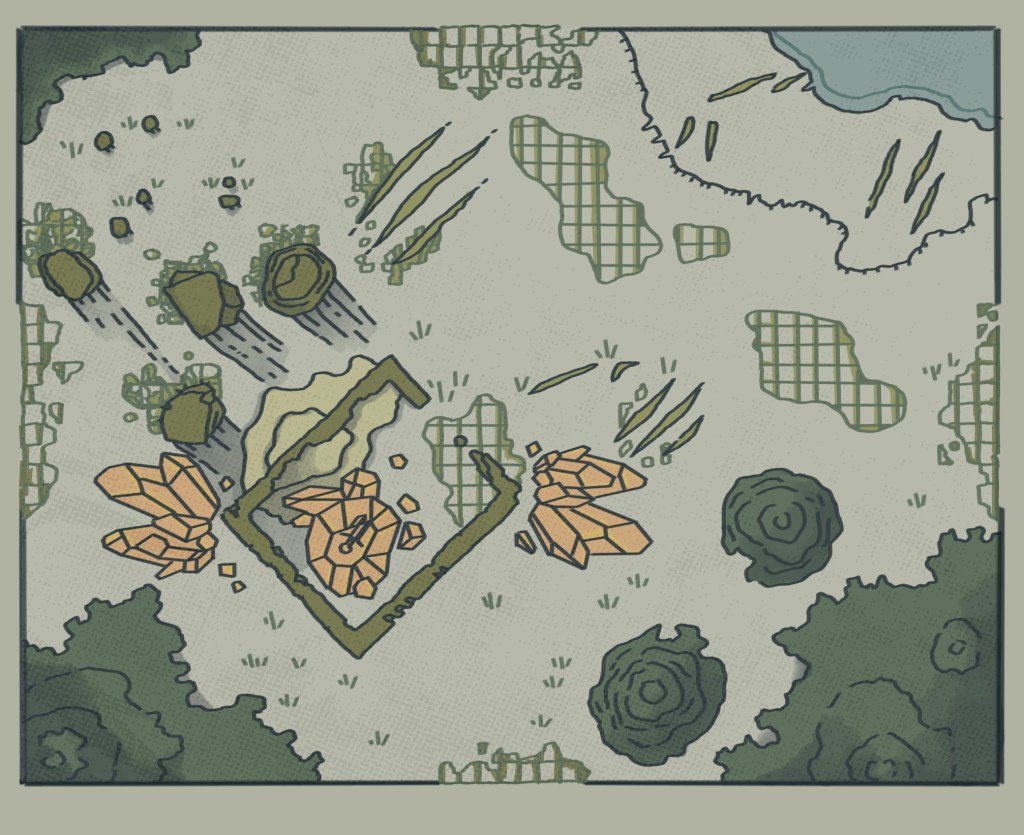
In the original adventure, the Dream Wyrm was meant to appear in any random chamber at the heart of the Night Garden. If I’d had the page count, I would have included a custom lair, so I wanted to share the map art for it now (and celebrate ranking #5 in the jam!).
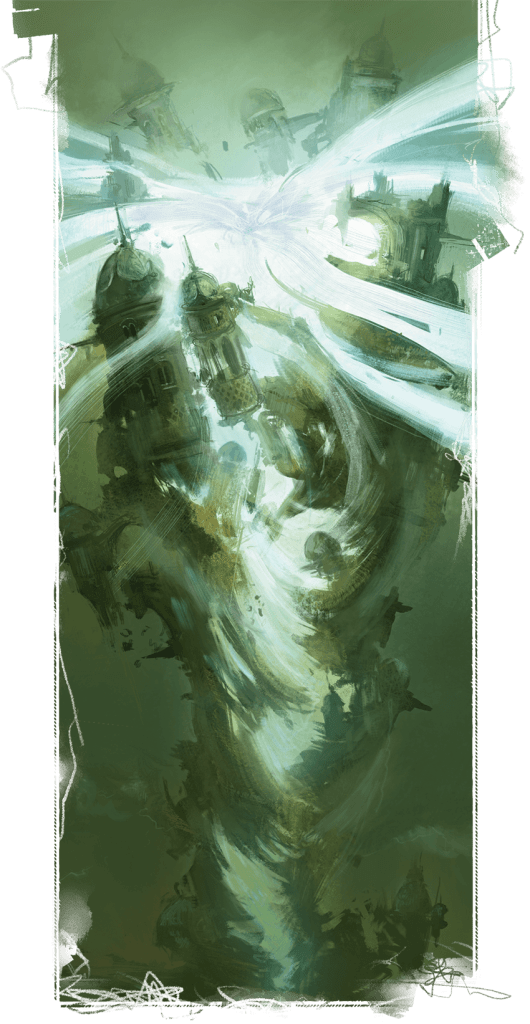
Towering mushrooms choke the slick, wet rubble of a once great courtyard; rain gathers in still, dust-covered pools around a tree-covered hill.
Mushrooms. Stinging pollen, very flammable. Stray sparks or torches might cause an explosion (2d6 damage). 25% chance/round when Near.
Courtyard. Walls are 30′ high, a fountain in its center. Coiled around the hill is the Dream Wyrm.
Pools. Covered in the Dream Wyrm’s sleep dust. Offers total cover from this attack when a PC is submerged completely.
Dream Wyrm Elongated body, twig-like limbs, insectoid maw. Carries an evershifting Night Garden in its wake and hoards the souls of those trapped within. AC 15, HP 58, ATK 2 rend +8 (2d12) or 1 sleep dust, MV double near (fly) S +4, D +4, C +3, I +4, W +4, Ch +3, AL C, LV 12 Sleep Dust. Fills a near-sized cube extending from Dream Wyrm. DC 15 CON or 1d6 CON damage. Targets who fail by 5+ points fall into a deep slumber until harmed or woken. At 0 CON, targets die and rise as a ghost (p. 217) trapped forever in the Night Garden.
Elusive. Avoids direct combat. Watches prey from the shadows, waiting for them to sleep.
Benevolent God. Can see through plants and animals in the Night Garden. Regards itself as a gentle shepherd guiding lost souls to peace. Unreasoning.
Vain. CHA checks to deceive it with flattery are Easy (DC 9).
GM Tip: Keep the Dream Wyrm’s tactics in mind. It isn’t going to stand still and get pounded by four or five PCs. It will likely try to retreat into adjacent rooms filled with other hazards and monsters, but this lair gives you a dynamic boss chamber to launch the encounter!
You can find the new art in the updated Maps zip folder, along with the updated PDF for Room Cards. If you liked this adventure, let me know with a rating on itch.
This was my original map, but after I wrote and released two adventures for the Deep Country and Deep Water respectively, I want to zoom in a little bit and think smaller for my borough.
Dare I say, I want to lean a little *cozier* for this borough. I want it to feel like somewhere the Players would actually want to spend time and invest in between adventures.
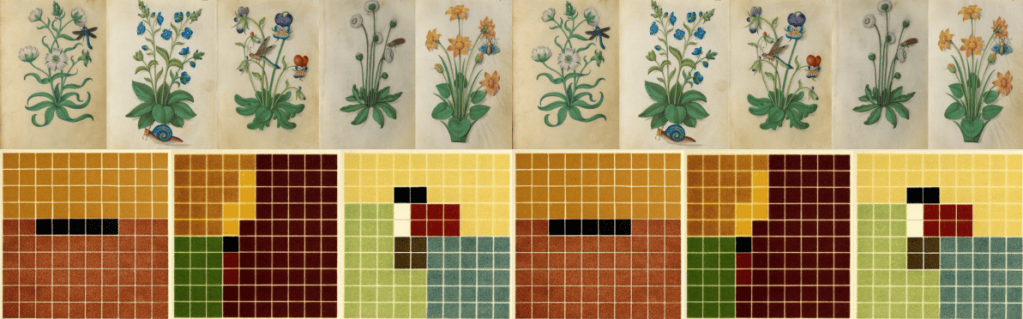
Collage includes art by Master of Claude de France and Emily Noyes Vanderpoel
Montstatique, the Borough on the Coast
Nonnegotiables. (1) The entire borough will be visible in a detailed, isometric map. The dollhouse perspective oozes charm, and I want the Players to be able to imagine themselves walking every step of this borough. (2) For the first time, I want to do hand-drawn portraits of each NPCs. I’ve really been into having quotes for NPCs to show off their character, so I’ll put those over each portrait like it’s video game dialogue text. (3) A mystery that involves each major location in the borough, if only in a small way.
(8) Park and Statue. Brutalist. A monument to nothing, really, but taken care of by the locals (who only work a few hours a week). A man throws a ball for his disinterested hound.
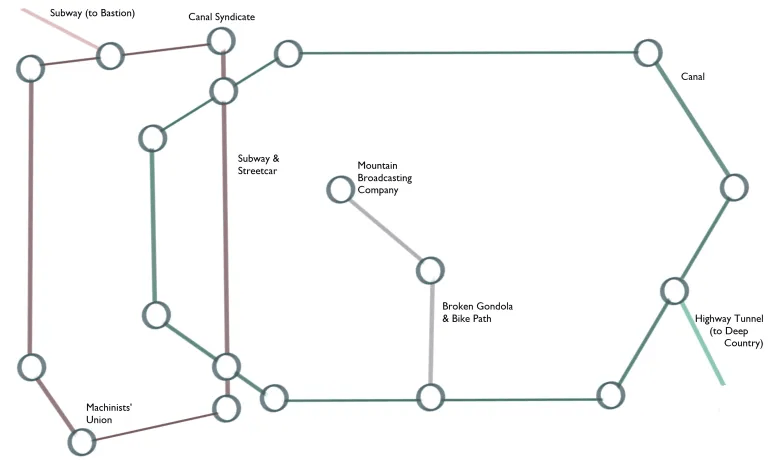
Montstatique West. A massive warehouse and boardwalk slough into the sea, it’s the home of the Machinists’ Union. A small, sheltered streetcar station in its shadow (the streetcar enters and exits a tunnel to the city and continues southbound toward the harbour–concrete steps into darkness; a steel door to the Underground. A 24-hour grocery store called Kwiki-Stop with two apartments above (tilting balconies overlook the park).
Central Montstatique. The mountain and a museum at its peak. It’s a collapsing wooden mansion, a radio tower juts out on top. The Mountain Broadcast Compay operates from here, surrounded by steep hills and overgrown, sealed-off ruins. At the base, there’s a park and a statue. A hydraulic bridge crosses the canal (its controls locked inside an operator’s booth). The ruined gondola marks the bike path to the mountain’s peak. There’s a middle tower and hanging passenger cabin just above the trees.
Montstatique East. At the edge of the canal, there’s a ramp toward the tunnel (a long drive to the Deep Country). Traffic is perpetually backed-up. Baby Cool Boutique is a clothing store and cafeteria popular with the locals. There’s rooms for rents upstairs and a sketchy basement weapons’ dealer below. Further east are ruins draped in beautiful textiles; the homes of local fishers and artisans (they hide many routes to the Underground and the hidden lair of the Canal Syndicate).
Key Locations
Boardwalk.
Warehouse.
Warehouse Rooftop.
Streetcar Station/Steps to Underground.
Kwiki-Stop.
Apartment A.
Apartment B.
Park and Statue.
Lift-lock.
Operator’s Booth.
Ramp.
Bike Path.
Ruined Gondola.
Abandoned Gondola.
Museum.
Radio Tower.
Forest Graveyard.
Baby Cool Boutique.
Basement Weapon Store.
Ruins/Rooftop Garden.
Factions
Mountain Broadcasting Company. Revolutionary youths broadcast weird hypnoses over radio waves. Recently they stole machine parts from the Union. They’re funded by the Syndicate through fronts throughout the borough.
Machinists’ Union. Consultants ritualistically rearranging the tangled wires of the broken-down gondola and interpreting divine providence from their everchanging conduction patterns. They’re contractually funded by the City of Bastion for another half-century.
Canal Syndicate. The Canal is ruled by subterranean monster-men hoarding treasure in the Underground. They deal in hallucinogenic river eels and smuggled goods. Recently they sabotaged the Highway Tunnel to try to seize control of the borough.
The Mystery/Spoilers for an Adventure-not-yet-written
A body inside the gondola passenger cabin. It’s the Professor, a newly-elected city councilor and a sympathizer of the MBC. He’s found well dressed, but no shoes and no watch. There’s a hole in his forehead, and £125 in his jacket pocket.
Before he was the Professor he was a regular customer of the Canal Syndicate who tried a new drug called slug. He opted for 100% purity, insisting he could handle it (he could not). The slug moved to his brain, hijacking control of his body. The slug-man was elected Councilor of the borough, and led the MBC. When they upgraded their radio technology, the slug burst from the Professor’s head (at the base of the trail). The Machinists who witnessed it moved the body to avoid any further issues with the locals (and maybe to blame the revolutionary youths?).
One of the Machinists, a young fisher brought in for his talent with rope, recognized the situation as involving the Canal Syndicate and ran (is still missing?). The Machinists stashed the body on the gondola passenger cabin at the top of the mountain. When the MBC youth discovered the body, they pushed the gondola down (but took the melted shoes and expensive watch). And I want one of the machinists to be a big, big guy who carries machinery on his back while he cycles. He took the body to the top of the hill, leaving deep gouges in the mud.
Last night I played Liminal Horror for the first time, opting to run the starting scenario Stopover at the Shelterwood Inn for 3 of my friends. Generally, it went pretty well and after so many years of running Into the Odd-likes, the rules were pretty easy to wrap my head around.
*I only read the rules once before playing: it seems to me like the main difference was the way the game handles critical damage. In Liminal Horror, critical damage causes wounds that are rolled for on a table (like in Mothership). Damage against a target’s WIL–in this game called CTRL–is referred to as stress and if a PC suffers critical damage from stress they roll on a fallout table and suffer a thematic effect. I was impressed to see that the starting adventure included its own fallout table unique to this scenario, which is something I hope is included in every Liminal Horror adventure.
All of that is to say that like in Mothership, Liminal Horror PCs are normal people who might panic and break down. This is handled really eloquently with the bones of Into the Odd and, in my opinion, is far superior to the way it’s handled in Mothership.
Art by Goblin Archives
I ran the adventure with very little prep, even by my own standards. Specifically, I read the adventure for the first time the morning of my session and then I skimmed it once more about 15 minutes before we played. I didn’t take any notes during my prep; the adventure is so well-formatted I’m not sure what I would have even written if I had.
I did spend about 30 minutes drawing a more printable map, though.
Art by Goblin Archives
I loved the pixel art one included in the adventure, but when I tried to print it with my black and white printer it turned into a formless blob. Like I’ve said before–drawing the map helps me meditate on how I will present the adventure to the players. But still, I made a crucial mistake that cut a lot of the tension from my session…
The mistake? I made the undercover agents too approachable, when they should have been a deadly threat. A shoot-first, ask questions later kind of threat. Think, the Working Joes in Alien: Isolation.
*** I’m about to spoil the adventure below but I think if you’re planning on running the adventure, it’s worth learning from my mistake.
So my players had just entered the A-frame lobby of the Shelterwood Inn. They found the door locked, and one of the undercover agents lets them in. He’s posing as the motel owner, but he’s actually an agent of the bureau here to clean up some Stephen King shit that’s going sideways in the basement. The actual owners of the motel are mold-people now, kind of like in Resident Evil 7, lurking in the dank waters of the cistern below the motel’s basement.
Art by Goblin Archives
So the man posing as the owner, Otis, locks the PCs in the Honeymoon Suite. Presumably to keep them out of harm’s way. They quickly broke out and snuck around to the back of the motel. After exploring for a while, discovering Otis is lying about being the owner, and seeing the so-called Sheriff acting really shady, they eavesdrop on a conversation between Otis and Claire.
Art by Goblin Archives
This is my missed opportunity: Otis tells Claire that he locked the PCs away, and he insists on making them a meal because he can’t let them go hungry. Nice guy. That was my mistake.
The adventure directed me to have him lock up the PCs, and that’s a great idea, but how Claire should have responded is this: “Otis, you were supposed to kill them. This is why they shouldn’t send the PR team into the field…” and give explicit orders to kill the PCs on site.
That would be scarier, and consistent with a clandestine agency bent on keeping more people from turning into mold.
Art by Goblin Archives
Once my players caught on to the idea that there was a bigger horror, they convinced the surviving undercover agents to team up with them and torch the big bad–Mr. Roosevelt–with Molotovs and shotgun blasts.
In the end, we had a great session. My players loved the highway setting–truly liminal, like the game promises, and the novelty of role-playing as regular people in is still really thrilling for most of my players.
I want to love this game, but there are three things I wish I knew before starting a short campaign–and one reason I was glad when it was over.
The tldr is this: I have mixed feelings about Public Access, I give 6.5 Odyssey Tapes out of 10. And if Public Access looks cool to you, you should absolutely run it–especially if you’re a new GM or running your first multi-session campaign. If you’re an experienced GM with an established flow and prep style, you might struggle with its rigidity and its eventual dissolve into tonal whiplash.
1. It’s too much paperwork.
I spent too much game time flipping through notes. Because Carved from Brindlewood clues are established reactively during play, completed mysteries still held crucial narrative threads for future sessions. Running this from folded papers and napkin notes quickly became a mess, and I repeatedly missed roleplay beats while hunting for buried, player-generated facts.
2. It’s not actually rules-light.
Between inventory, Side Character perks, past adventure rewards, Conditions, and Keys, players have a surprisingly large ledger to track. During tense moments, I found myself breaking character to nudge players to utilize all their abstract mechanical resources.
3. The GM doesn’t get to roll.
I missed running characters with set drives and concrete failure conditions. Because the game relies so heavily on improv-driven truth, even an NPC’s core nature is fluid until a clue or roll locks it in. I found myself gravitating toward hazards like Darryl Rodenbecker over Side Characters simply because hazards possessed stable, fully realized definitions.
All that Being Said…
These design choices are all undeniably intentional. The system gets you 85% of the way to a unique aesthetic with minimal traditional prep. So if you love constructing conspiracy boards and cross-referenced journals, you’ll probably adore it. And for first-time GMs Carved from Brindlewood guidance belongs on the required reading list alongside the Mothership Warden’s Operations Manual.
Art by the Gauntlet
Why I’m Glad It’s Over
I ran Public Access for 10 Sessions. As our campaign progressed, each session yielded less joy for me than the last. Reading this review by Fail Forward helped me identify the source of my dissatisfaction: tonal whiplash. Fail Forward notes that the overarching narrative is “a romp to a degree that no other part of the game is. It’s a slasher at best, and a comedy action-flick in a Spirit Halloween at worst”–and my table proved that right.
In Session 3, as my players were searching for the Black Leaf Circle, a failed check brought one if its members Godpanther through a staticky, dimensional door. I asked Timothy’s player to make a Day Move to avoid being overpowered by the cultist. Timothy invoked his wallet-chain for advantage, whipped Godpanther across the face, and sent the sorcerer-cultist fleeing in pain. It had an awkward, Coen Brothers/Barry violence to it that was fun in isolation, but it completely drained the cult of its cosmic threat going into future encounters. Later, when two latchkey kids literally stomped the amusement park anomaly from Starlight Kingdom to death, my ability to maintain analog horror-atmospheric tension collapsed entirely.
Like Fail Forward put it: “it’s the Mystery Gang tripping up an eldritch abomination with a wet bar of soap.”
Nagging Thoughts
All of this leaves me with more questions about the medium:
Can pure horror ever survive player agency in TTRPGs, or is camp inevitable? When players have strong mechanical tools to fight back or manipulate narrative reality, tension naturally degrades into action-comedy.
High-impact moves vs. Slow-burn dread. Analog horror relies on unexplainable, lingering dread. But PBTA engine design rewards high-impact choices and immediate resolution–two mechanics that actively undermine slow-burn fear.
Designed to end. I deeply respect that Public Access has a finite campaign arc. Too many games assume infinite modular play. I only wish the game’s finale was designed with the same eerie restraint as its opening act.
Lessons I’m Stealing
Despite my bouncing off its rigid campaign structure, Public Access left me with three brilliant design ideas I plan to steal for my next campaign. If anything, playing it reignited my excitement for emergent, serialized play.
1. Have players define the consequence before they roll.
This is tailor-made for high-stakes games like Mothership or Into the Odd, where rolling is a desperate last resort or a save against guaranteed harm. Pitching compelling, fail-forward complications on the fly is mentally exhausting for a GM. Asking players “What goes wrong if this fails?” before the dice hit the table completely shifts that cognitive load. If their proposed consequence feels too tame for you, you can always “yes, and…” it to dial up the danger but at least they’ve gotten your gears turning.
2. Leave structural gaps in your prep for player theorycrafting.
Leaving mysteries unresolved and incorporating player theories into the lore is S-tier advice that many GMs admire but struggle to practice without a net. Certainly that was the case for me. While the Carved from Brindlewood framework ultimately felt too rigid for my GMing style, its core principle is invaluable: leaving explicit blank spaces in your campaign prep forces the spotlight to remain firmly on the players’ observations and hypotheses.
3. Reserve two-thirds of session time for predictable, player-driven play.
The structural contrast between Day and Night phases creates a fantastic gameplay rhythm. During the Day, players drive the action, their plans generally succeed, and they explore their own personal agendas without constant threat. At Night, the dark forces retaliate and failure carries sharp teeth. You don’t need a rigid phase set up to accomplish this. For example:
Dungeon Crawls: Safe town prep and wilderness travel serve as the “Day,” while deep dungeon delves become the high-stress “Night.”
Sci-Fi Horror / Mothership: Routine maintenance, cargo runs, and shore leave represent the predictable “Day” before things inevitably collapse into horror.
Giving players a generous, reliable window of low-threat agency makes the eventual turn to high-stakes danger hit much harder, and allows them to express a lot of agency.
You might have noticed that most of my favorites are among the best-looking adventures posted. Real 5-star visual designers. Does that make me shallow? Illiterate? Maybe.
But aren’t visuals also design? And are we not designers first?
It’s been a little disorienting looking at so many adventures presented in so many different ways. Each one a puzzle box until the moment its designer’s intent reveals itself like so many plump little pearls rising from a bed of muck. Busy pages, low contrast, baffling color choices. Yuck.
It’s like some designers treat the single page of a jam like an exam cheat sheet: cramming every line from the textbook onto every square centimeter.
My guy, it has to be legible.
Why are so many indie adventures so hard to look at?
I wasn’t really planning on making anything else this summer, I’ve been busy enough finishing my campaign of Public Access (speaking of baffling decisions: why didn’t I read that campaign before committing to run it? But, more on that in another post…) and trying to make the most of the very short summers in my corner of the realm. But, when RedMageGM announced he was hosting a Mystic Wood OSR Adventure Jam based on the Lost Woods/Mirkwood from the Legend of Zelda/the Hobbit I knew I had to join the jam. I’ve already designed a randomized open-air dungeon; I knew I could make something even better by leaning into the fairytale/folklore vibes for this jam. The idea came basically fully formed.
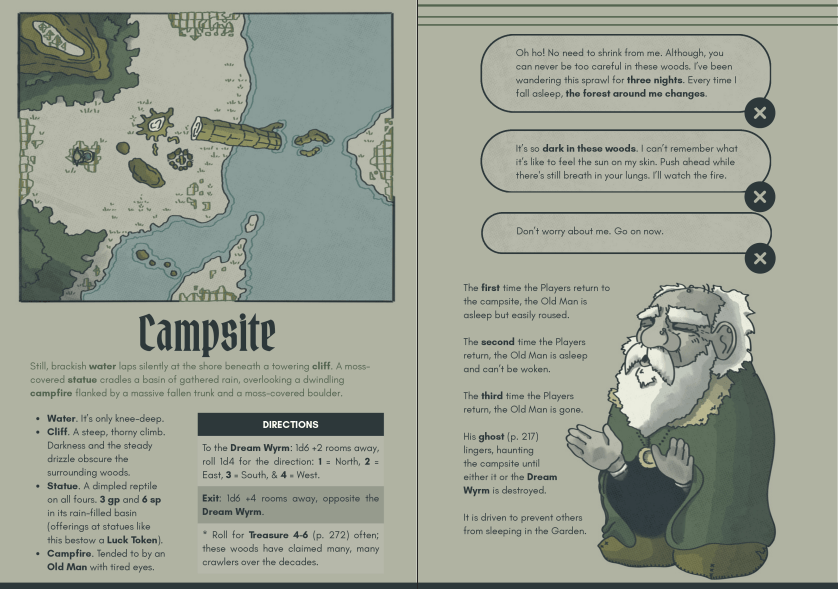
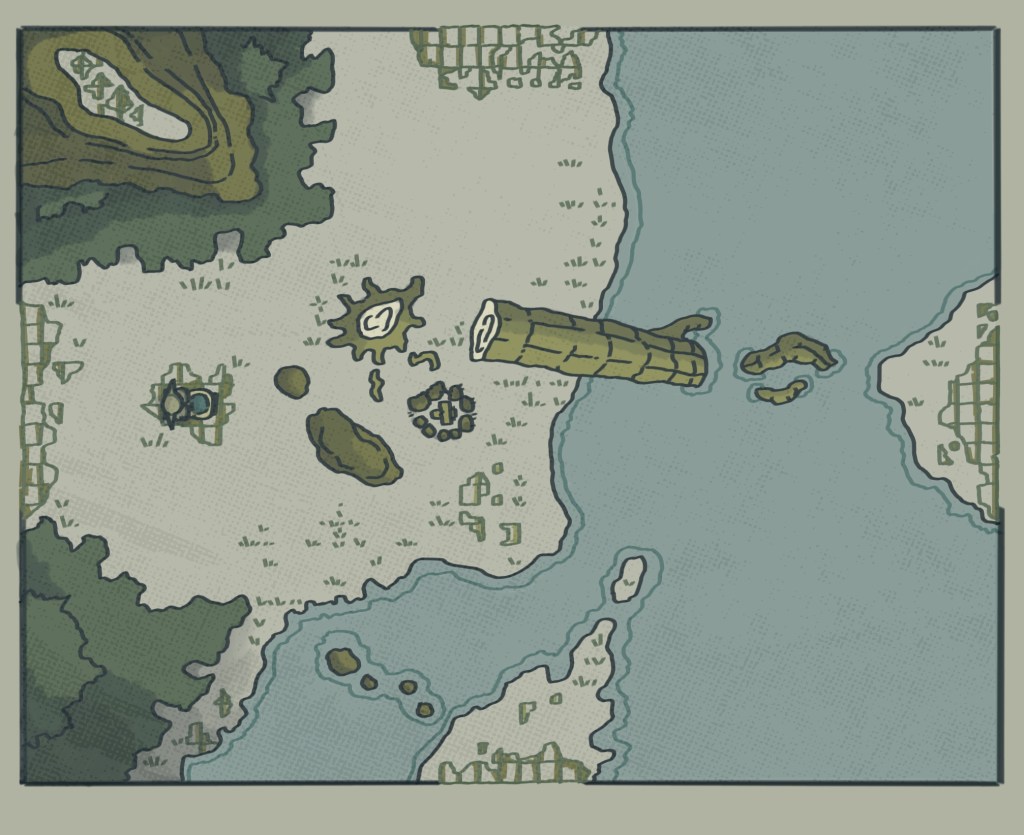
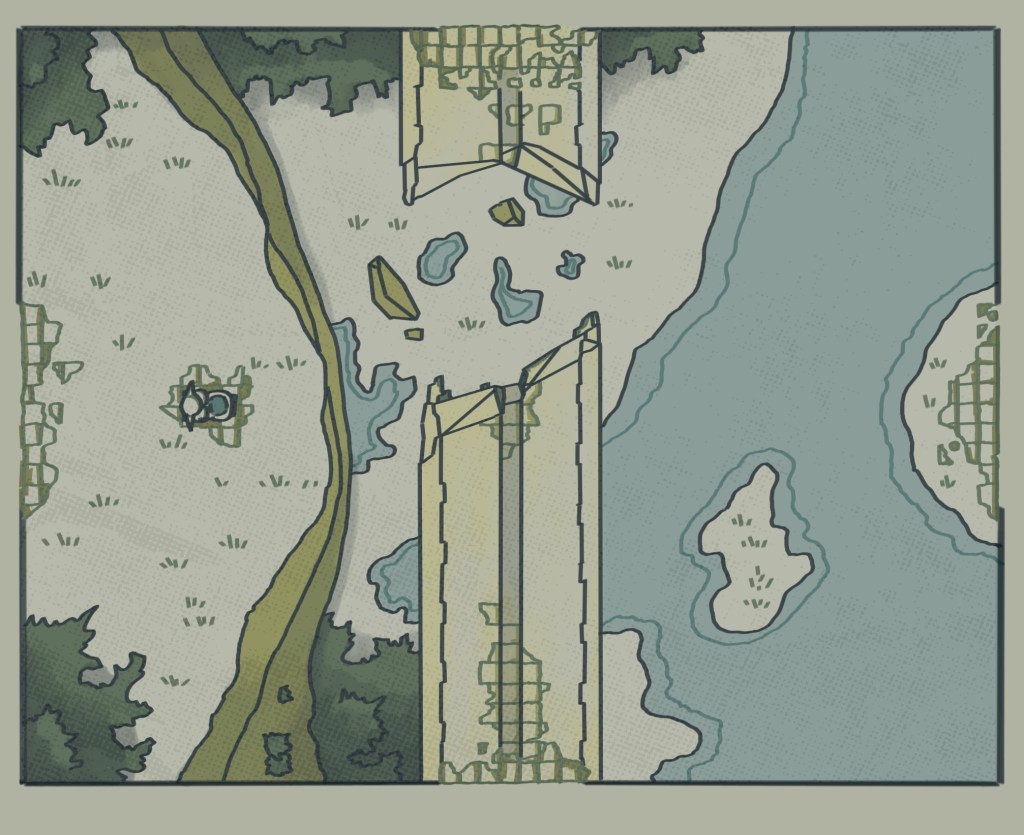
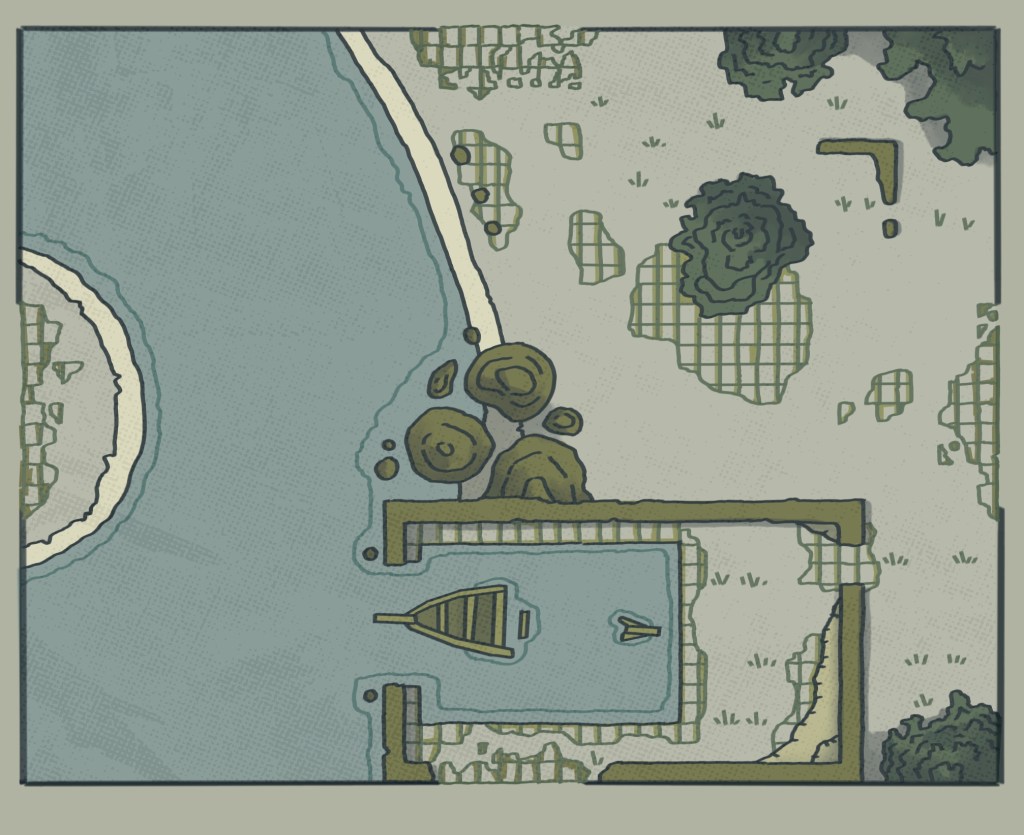
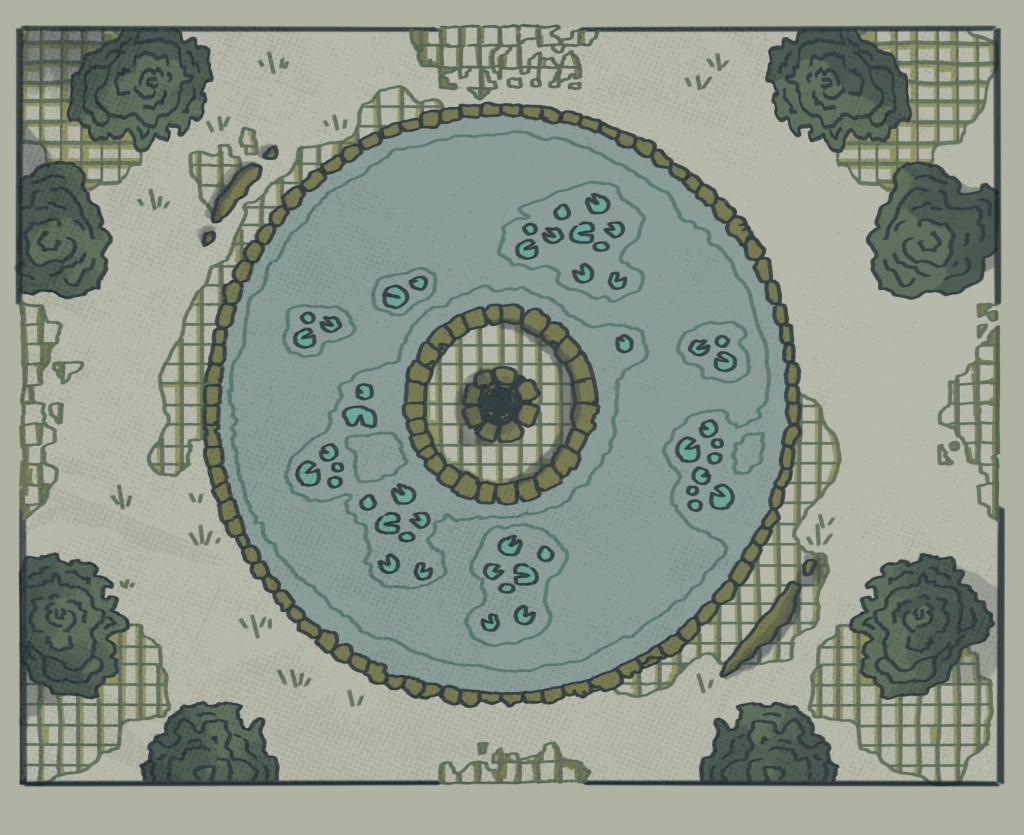
I knew from the hop I wanted to evoke an old Gameboy vibe. I remembered that in a live stream Chris McDowall referred to Alec Sorensen’s art as “Gameboy colours” so I looked at the botanical borders on each page of Mythic Bastionland for the basis of my palette.
After drawing the Campsite and Spirit Village, the style guide was locked in, leaving me free to simply draw and imagine what became of this once-great kingdom. The narrative grew naturally from the art.
I’ve often said that visuals lead my design process, but it actually runs deeper than that. Visuals don’t arrive fully formed but they emerge through a kind of meditation. Spending hours in a state of flow over a single drawing allows ideas to simmer until they feel as grounded and genuine as real-world memories. Drawing the world doesn’t just illustrate it; it makes it real. And once a place becomes real, designing it feels entirely intuitive.
The adventure is free on itch.io, you can check it out right here. Even if the adventure itself has no appeal to you, I’m sure these 20 map tiles could be arranged into a fun open-air dungeon of your own making.
You know what’s cringe? Falling in love. Telling your friends that you value them. Getting earnestly excited about your hobbies. Being vulnerable with others.
You know what else is cringe? Asking acquaintances in your life to play ttrpgs with you, and getting over the fear of mixing different groups of people in your life over a shared hobby.
It’s pretty cringe to go up to someone and ask them what kind of fiction they like, to talk to them about their favourite books and music and movies in an earnest, curious way and then invite them to try a social, collaborative storytelling game. You might have to explain that these games often lean into pulpy, action-movie stakes. It’s just an excuse to solve wild problems we’d never encounter at our day jobs. Plus, you get to do funny voices–you don’t have to, but you can if you want to (I do when I’m inspired to).
You get to practice being a hero, it’s pretty cringe.
Art by Claudine Bouzonnet-Stella, Jacques Stella
If you’re looking for players, you need to ask the people that you know and meet them where they’re at. A lot of them might surprise you. I play regularly thanks to advice from articles like the open table manifest by the Alexandrian.
It’s pretty cringe to be worried about how you look if you’re doing what you love.
My submission to the Appx. N Jam 2026 is now live on itch.io, you can check it out right here. The adventure turned out differently from my initial thoughts once I got to the art phase of the project. I thought it could be a fun exercise to compare how my ideas translated to the page, and dig into why I made the choices that I did.
I was limited to four A5 pages (in other words, both sides of a single, letter-sized piece of paper), so let’s take a look at each page in order.
Cover Page
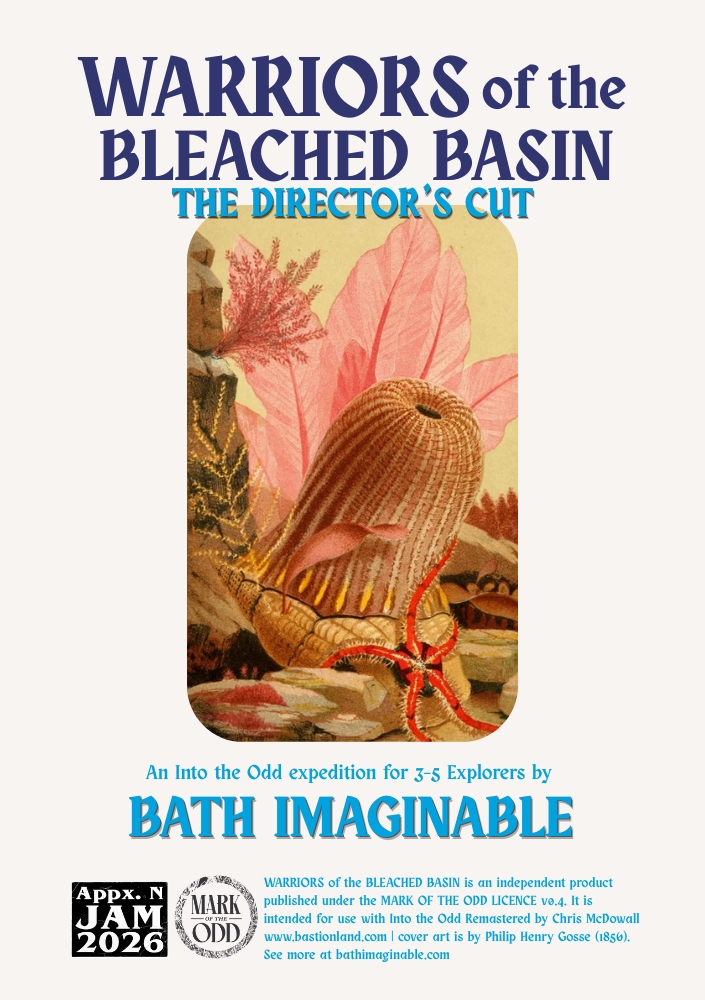
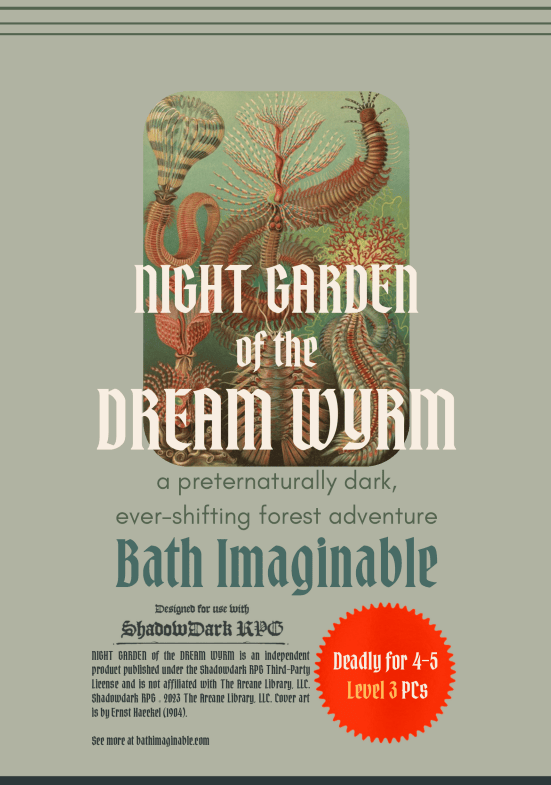
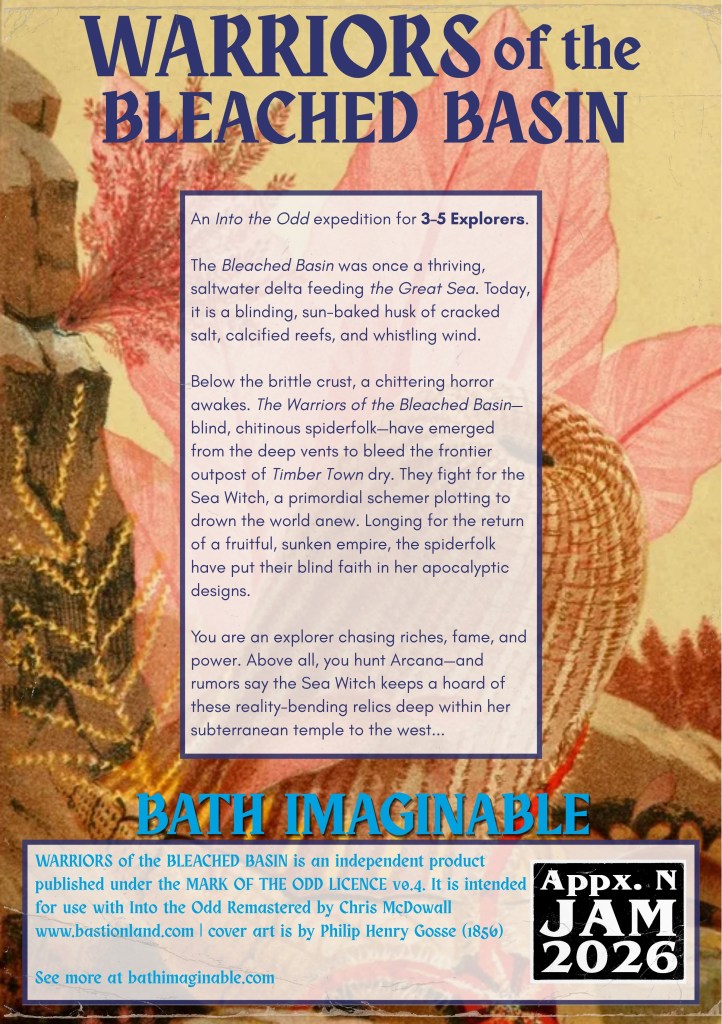
I knew I wanted a cover page, despite it occupying 25% of the available space. I originally thought I would draw one of the industrialists from Timber Town wielding a fire whipper and keeping a couple of reptilian warriors at bay, but none of those ideas made it into the final draft and when I started diving into public domain illustrations of corals, I fell in love with the alien vibe Philip Henry Gosse’s 1856 illustrations brought to the cover. The font and color contrast helps sell the science-fantasy vibes without many words.
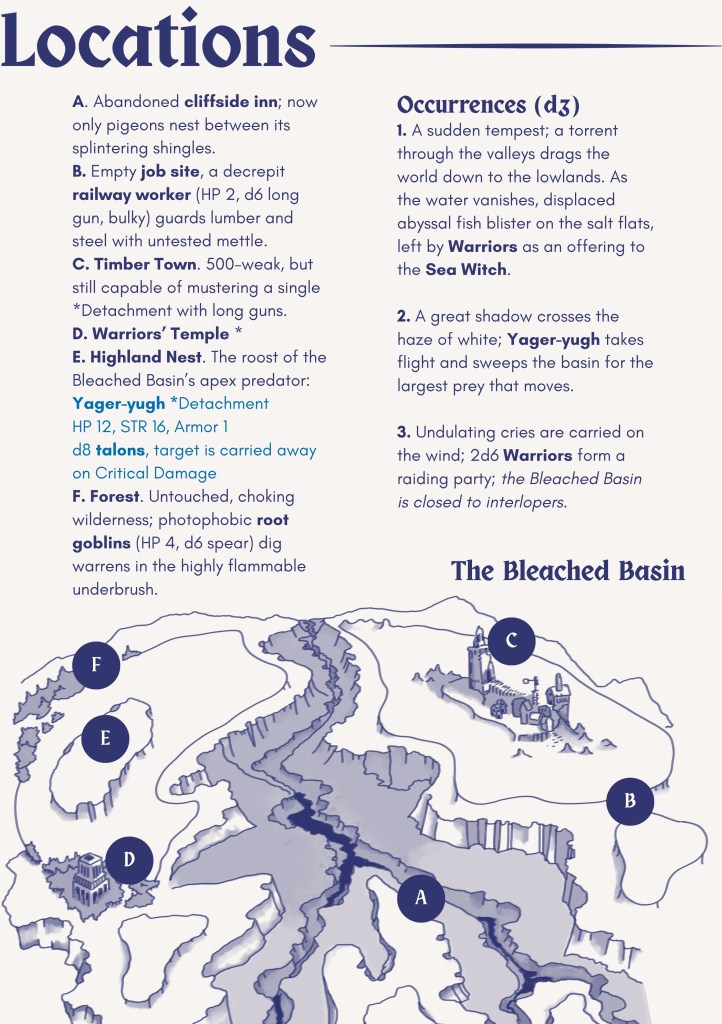
But there are still words. I wrote previously about the good use of verbs in the Cairn adventure, In a Petal Unlimited, so I wanted to make sure my cover page also provided a clear hook: find the treasure.
I had wanted to offer six hooks as an opportunity to expand the worldbuilding, but decided not to; I’d prefer more of my precious word count be spent on describing the setting and its inhabitants knowing that an inspired GM could find other implied hooks. I’m a big fan of iceberg theory.
Dungeon Key
Originally, I thought the entire adventure would be a wilderness crawl, but after pushing my ideas into the proverbial brown-bag of the back of my mind to let them ripen, I decided that a tight, five-room dungeon could offer a lot of narrative in a limited amount of words.
I had always planned on there being a couple of adventure locations on the map, but I combined the ancient lighthouse and warriors’ temple ideas into a single location and cut anything that didn’t add to the story.
I don’t usually add “if this, then that” type text to my adventures, but since this one is designed to be a one-shot I thought it would be fun to add some world-changing stakes. The Ritual also ties in Yager-yugh from the final page, and offers a potential moral dilemma for outsider player characters not endeared to Timber Town.
Maybe it’s just me, but I find the Sea Witch much more sympathetic than the folks of Timber Town given our real-world man-made ecological apocalypse is already well underway.
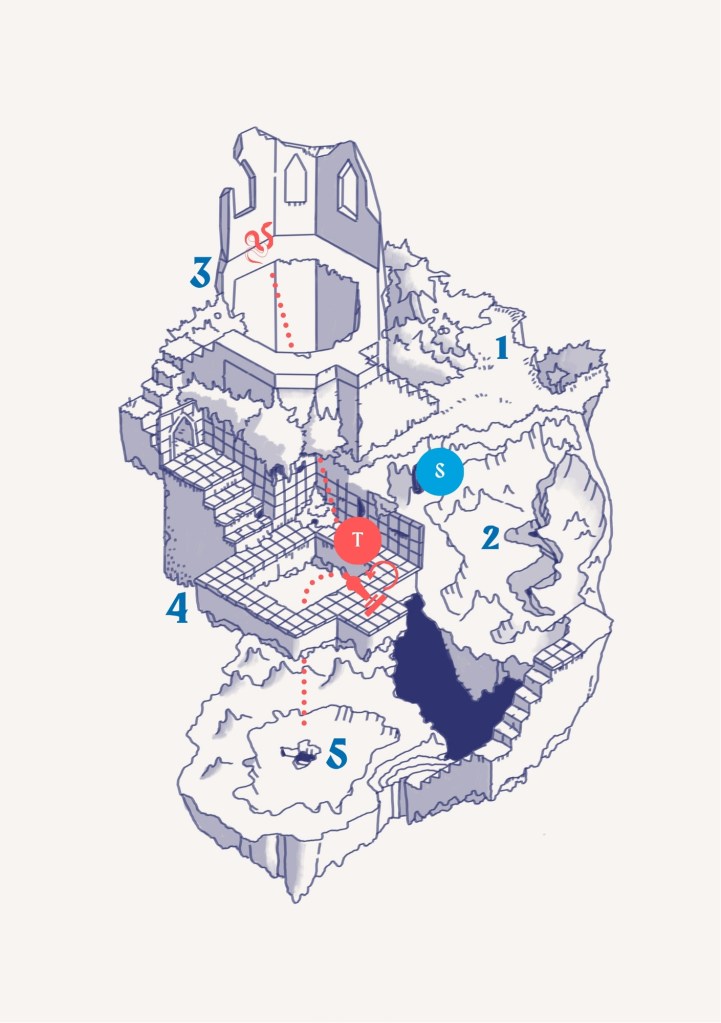
Dungeon
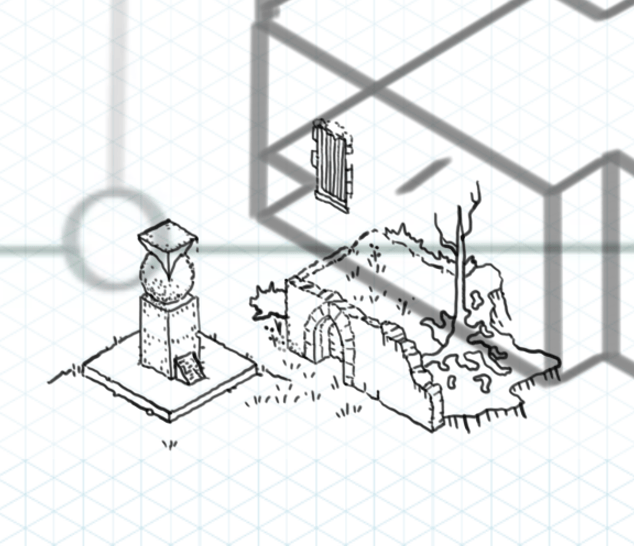
My favourite thing about isometric dungeon maps, besides their dollhouse-like vibes, is the way they communicate verticality. I really wanted to lean into that with this statue trap, set up by the Warriors to get the jump on anyone from Timber Town (or other nosy explorers) looking to rob the temple or interrupt the ritual.
The isometric perspective also makes it very clear how all of the rooms connect, which is important when my word-count is so limited. I didn’t have to spend any time describing how a fall from 3 leads straight through 4 to 5; it’s clear in the visual design.
Back Cover
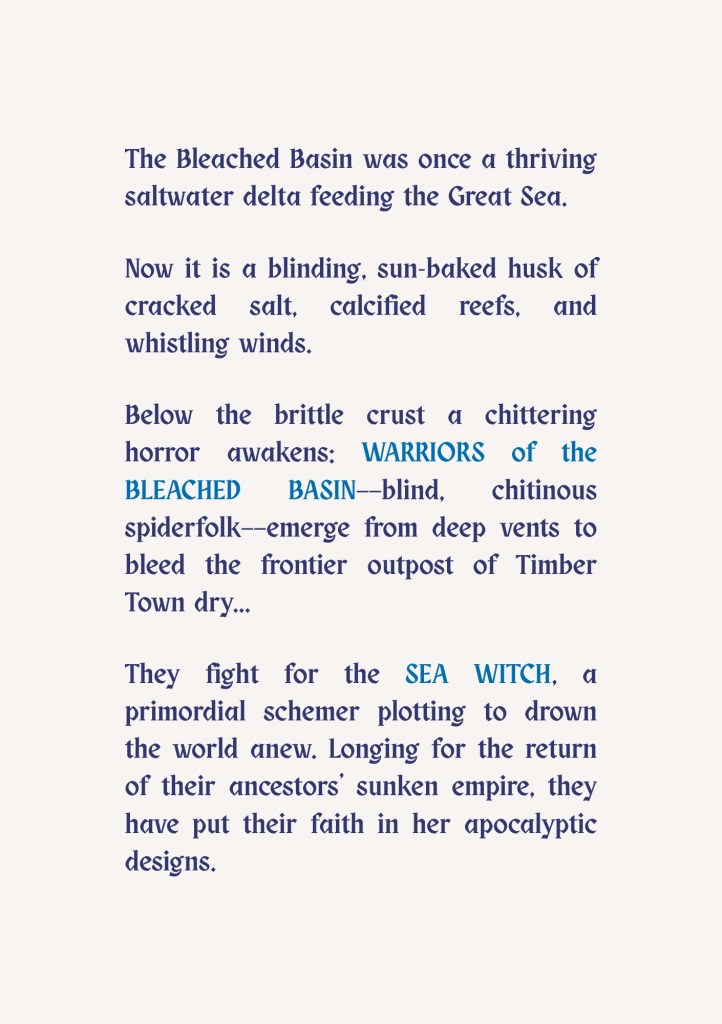
This is the first page I finished and it’s actually the closest to my original post. It was while working on the drawing of the Bleached Basin that many of my ideas calcified, while the rest fell away like brittle, grasping fingers of bleached coral. For me, I discovered, the visuals lead. Without the pressure to put my ideas into words, and with hours ahead of me to draw, think, refine, and draw again, the entire setting *develops* in my mind like a photograph darkening to reveal itself.
I’m most proud of this final page, really, because it communicates so much about the harsh reality of living in this place with very few words.
Conclusion
I’m really happy with how this adventure came out, and I’m grateful to the Appx. N Jam judges for taking a look at it. This isn’t something I would have come up with if it weren’t for the imaginative prompt I was provided with and all of the awesome inspiration I was filled with looking at last year’s submissions.
One of my favourite things about Ravenloft is its wacky worldbuilding: each Domain of Dread is a mind-prison tailored by mysterious Dark Powers to eternally torture its Darklord. Made of shadowstuff and the Darklord’s own memories, these domains are unreal yet populated by very real, trapped souls.
The most famous Darklord is Count Strahd, imprisoned in Barovia and tortured by repeated reincarnations of his beloved Tatyana. The campaign’s most horrifying reveal is that this loop repeats endlessly just to punish Strahd, regardless of the collateral damage. You are, effectively, meaningless in a cosmic struggle between an asshole and an even bigger asshole.
Art by Wizards of the Coast
Darkon stands out among the domains in Van Richten’s Guide to Ravenloft (2021) because it is on the brink of destruction. Before your campaign in Darkon even begins, the Darklord–the Lich King Azalin Rex–has already won. He escaped.
During the Hour of Ascension, Azalin vanished, leaving Darkon to dissolve into the mists. Without a Darklord to punish, the Dark Powers have no use for the domain, and the Shadowfell is reabsorbing it. As the mists fracture the land, familiar people and places simply fade from memory.
The authors write:
“Despite facing gradual annihilation, Darkon’s living population largely ignores the threat, dismissing reports of vanished regions as rumors and fearmongering.”
And this is why I can’t stop thinking about Darkon.
Art by Gladys Amy Mock
On Saturday, my city broke a 100-year temperature record. The heat, paired with 85% humidity, triggered intense nausea, headaches, and a profound sense of anxiety–and I’m a healthy 32-year-old with no respiratory conditions.
Friend-to-pedophiles and eBay billionaire Peter Thiel is planning to leave society behind for a floating, libertarian nation built for profit. Epstein-black-book-reject and son-of-an-emerald-baron Elon Musk plans to leave Earth altogether for Mars, having already become the world’s first trillionaire when SpaceX went public. Piss-bottle-enthusiast and Amazon founder Jeff Bezos has expressed a similar desire to abandon the world he helped to ruin.
While it is tempting to compare the elite billionaire class to Azalin Rex or other Darklords of Ravenloft, the reality is much more terrifying: our world is a rudderless ship drifting on the currents of capital, and no one can stop it from crashing into the rocks. The fallout of the impending climate disaster will kill more people than any historical atrocity. Despite their immense creativity, the writers at Wizards of the Coast cannot engineer a Darklord whose evil rivals the real-world systems that are set to doom us all.
Yet, one element of their worldbuilding remains hauntingly accurate: how people respond to the inevitable end. Like the citizens of Darkon, we will be forced to watch the people, places, and traditions we love disappear first from reality, and then from our collective memories–like so many souls lost to the mists. To speak of it will be dismissed as fear-mongering and rumors.
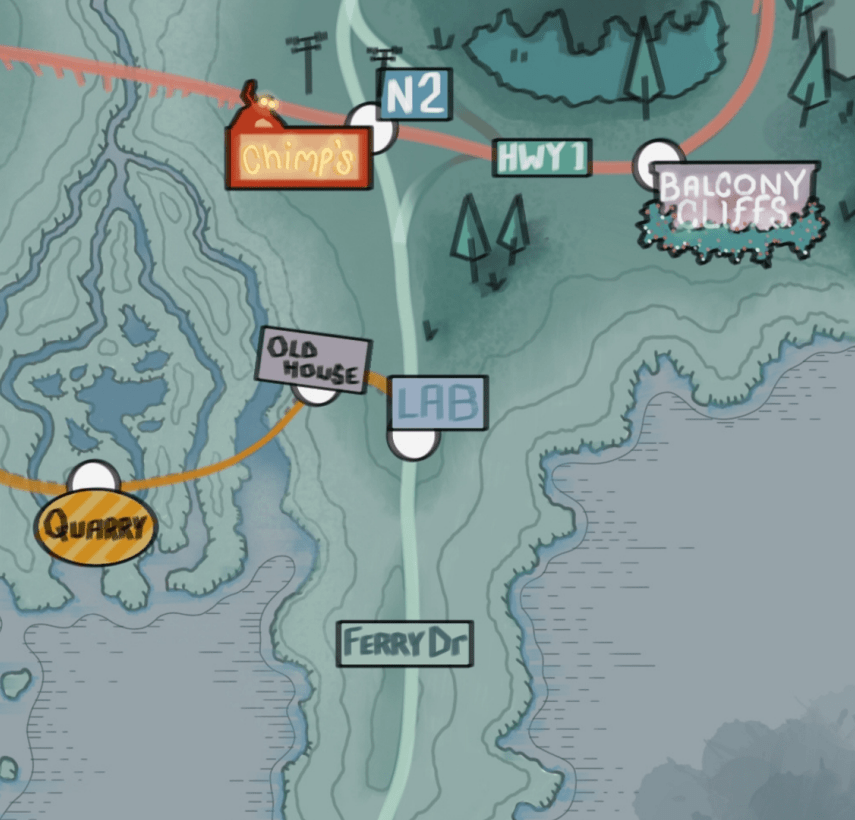
Old House. The Byron family refused to move, even when the Lab came. No one knows what happened to them, or their infamous collection of antique coins.
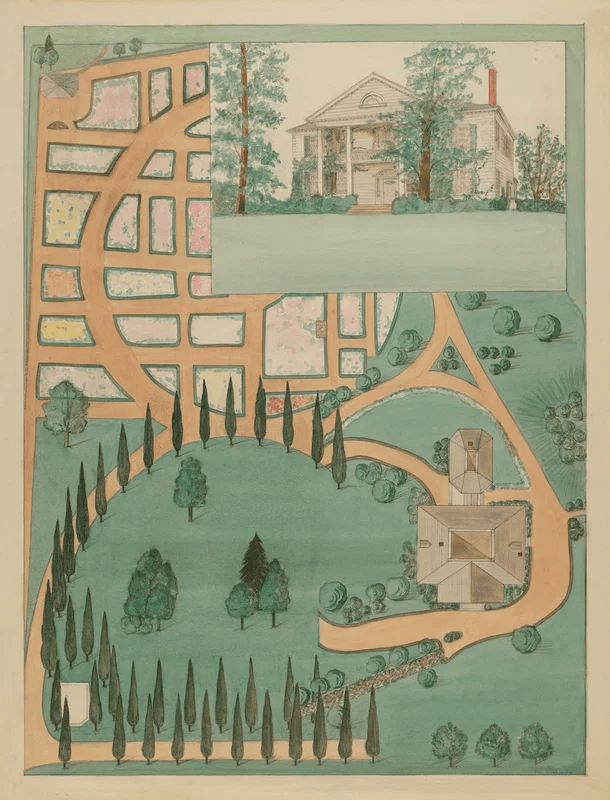
Art by Virginia Richards
I wrote previously about how my adventure was inspired by Kelsey Dionne’s Cursed Scroll #1 for Shadowdark RPG. Kelsey described the Gloaming with a couple of terse, evocative sentences for each location, and left room for me and my table to make it our own.
“509. Outlaw Camp. 30 bandits camp here led by Greaves Redthorne, an outcast Knight of St. Ydris. Greaves, a cunning liar, serves the marrow fiend Unduluk, who is only a few moons away from erupting from the marrow tree at the center of camp. Unduluk needs protection from the Knights of St. Ydris (1406) for now, and human flesh after its apotheosis. The bandits do not realize they serve as both.“
These four sentences served as the spark for a fiery manhunt arc, none of it written explicitly in the text of the adventure. When the party set a trap for Redthorne on the bridge outside of Marin’s Hold, the only thing I knew about the guy, really, is that he’s a cunning liar.
As Redthorne approaches the bridge to meet with my players (for plot reasons), something is off. He hasn’t seen anyone travelling to or from Marin’s Hold all day. He lets the wind wash over him, breathing in the scent of the forest. He succeeds on a WIS check (his cunning). He raises a hand, the bandits stand motionless.
My players watch from the trees–ready to ambush–as the bandits form a tight huddle around their leader. Redthorne casts shadowdance, weaving shadow stuff into an illusory version of himself who walks confidently onto the bridge with more than half of the bandits (his deception, and his willingness to sacrifice the bandits).
My players spring their trap. Their archer/fighter fires a flaming arrow at the payload of explosives strapped under the fragile bridge. All of the bandits are killed in the explosion, torn apart and scattered with the bricks into the murky river below, but Redthorne dissolves into shadow. He steps toward the flame, ready to fight like a demon to his bitter end.
It was an epic conclusion to a great arc, and while none of it was spelled out for me by Kelsey, I feel like all of it was consistent with her design, her writing, and her worldbuilding.
Page 11 of my adventure lists 6 treasure sites with one sentence descriptions for each, naming a treasure and hinting at a danger within. In an earlier blog post, I had a lot of fun expanding on the Lakeside Lodge and ended up with a Shining-esque creepy mansion full of fish ghosts.
Let’s do that again, only this time for the Old House. Maybe we can answer some questions about the eponymous Byron Family and their so-called infamous antique coins.
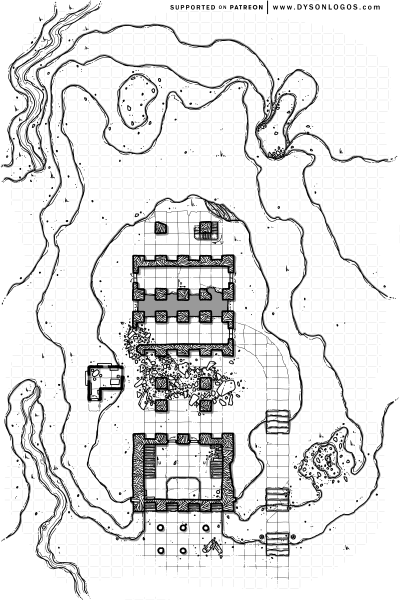
Map of the Old House
As per usual, I go to Dyson Logos. Obviously, I love drawing maps, but I’m not a machine, I can never draw all the maps I need. And I want to play tonight.
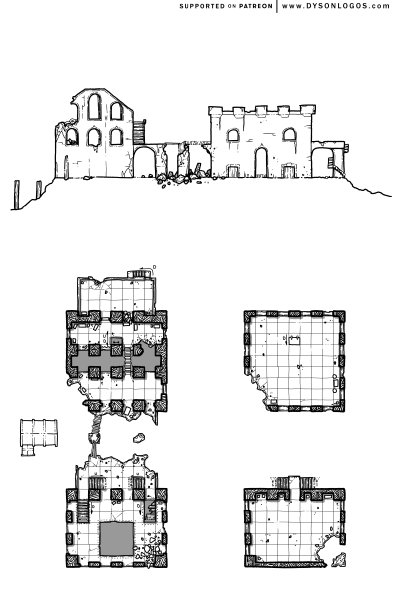
I like this map and its counterpart. The Byron’s have been gone for over fifty years and the Old House was built in a *coastal vulnerability zone* (in other words, it’s been battered by the elements). Here we can see that only the brick elements remain and a lot of the wood/plaster/ceramic has fallen away. A small wooden shack on the west side of the mansions’ ruins is home to Granny Byron.
Granny Byron HP 8 Driven to hold onto her antique coins forever and ever and ever. STR 18 Bite (d10), false teach shatter on Critical Damage (d6 Blast) Adapted. Granny Byron has held onto these coins for a long, long time. She can perform any mundane action without the use of her hands.
Antique Coins. Just a normal box of antique coins. To the right collector in Bastion, easily worth £1,500.
OLD HOUSE ENCOUNTERS Roll d6
1. Jack Byron wants you off his property. He’s tired of pesky Lab workers picking through his trash. If you know where Sophia is, he’s much more agreeable
Jack Byron HP 6 Driven to help his mother rest. Armour 1 (Breast Plate), STR 12, CHA 12 Shotgun (d8, Bulky)
“Those jackoffs at the Lab think they can take what they want, like city folk are so much smarter than us country folk. Wait a minute, where did you say you were from again?”
2. Janet Byron gardening around the ruined mansion’s exterior. She’s more welcoming of guests than her husband, but flies into a rage if anyone points out the dreadful state of her home.
Janet Byron HP 8 Driven to redeem herself in the eyes of her mother-in-law. Armour 1 (Chainmail), DEX 12, CHA 12 Rapier (d8)
“Those antique coins are all we have left. Sophia needs to take over holding them for her grandmother, it’s her duty as her father’s eldest daughter.“
3. Ricky Byron setting bear traps all throughout the property, hidden under the brush. He isn’t interested in the Players, unless they’re willing to share stories of their violent exploits.
Ricky Byron HP 4 Driven to see others in pain. CHA 8 Stinky Blade (d6), DEPRIVED on Critical Damage
“Ricky doesn’t give a shit about those coins. Ricky doesn’t give a shit about you.”
Bear Traps. Hidden under the brush, difficult to see because of all the litter and debris. Causes d6 damage and stuck for 1 Turn.
Art by Ohara Koson
4. A dozen white rabbits emerge from the lowlands to the west and dash through the property toward the road to the east. One of them stops and looks at you for a moment, as if lost in thought, before reuniting with the others.
Retter, the Original White Rabbit Driven to hide in plain sight. Armour 1 (Blue Flames), CHA 14 Moonbeam (d10), permanently blinded on Critical Damage
5. Four Field Agents in rubber hazmat suits scanning the Old House with strange machinery. They will encourage the Players to leave, for their own sake.
Field Agents HP 4 Driven to find the Original White Rabbit. Armour 1 (Hazmat Suit) Snare Pole (d8, Bulky) ensnared on Critical Damage or Concealed Pistol (d6)
“I can’t believe you’d be here without the proper protection… I guess you people will do anything for a quick buck.”
6. Three Ferrymen looking to steal those antique coins they heard about. One of them managed to pry the box of coins from Granny’s hands, but she’s relentless. She got them back.
Ferryman HP 3 Driven to find some treasure and get back to the Lighthouse. CHA 12 Pistol (d6) or Switchblade (d6)
Final Thoughts
So, here we have a potential standoff at the Old House. Everybody has conflicting drives, and the verticality of the map makes it a potentially interesting stand off (if it comes to that).
I wouldn’t describe the entire location in a lot of detail for the Players, just print a blank map and put it in front of them.
Print one for yourself and write directly on the map: decide where a few bear traps are, put something useful but inexpensive in the treasure chest on the upper levels. I would put one of the Coastal Oddities from Page 37 in there, if it were me.
The chest requires 7 antique coins be inserted into the lock-slot to open (lessening the total value of the coins to £1,200).
For more hazards and obstacles, don’t forget to look at “34 Good Traps” on Page 304 of Electric Bastionland. For this map, I would choose the following:
(6) “A column of light. When a being enters they are frozen, and an evil duplicate of them is conjured. The victim is only freed when the duplicate is killed.” Put this on on the southern altar.
(21) “Rope bridge primed to split in the middle when the majority of the crossing weight has passed the midpoint. The characters can grab their half of the bridge and climb back up easily enough.” The last bit of ruins connecting the upper levels.
(13) “Glossy, friction-less floor and spiked walls.” Seems like something Ricky Byron would do. On the top floor of the southern structure, he’s poured motor oil all over the floor and fixed sharp metal and glass to the remains of the walls. On top of that, there’s a risk of falling in the southeastern corner of the room. Ricky will try to trick the Players into going up there if he can.